Tunable diode laser absorption spectroscopy (TDLAS) is a technique that offers a high level of sensitivity and selectivity in measuring specific species in a gas stream. This extractive method offers a fast measurement for both wet-to-dry and dry-to-wet conditions, and is not affected by the presence of methanol, glycol, or hydrogen sulfide. The basic setup only requires a tunable diode laser light source, transmitting optics, absorbing medium, receiving optics, and detectors.
The benefit of this technology is that in a complex mixture of hydrocarbons and other species it is possible to pick a specific wavelength to measure the absorption of a specific species.

Figure 1: Example of a spectrum of complex gas
By selecting the appropriate wavelength to transmit and measure, energy is only absorbed by the species of interest, eliminating the need for filters that can require periodic replacement. The laser passes through the sample gas and a certain amount of energy is absorbed from the analyte. The amount of energy that is absorbed can be related to the concentration present.
Figure 2 shows an example of energy absorption in the presence of varying amounts of moisture.
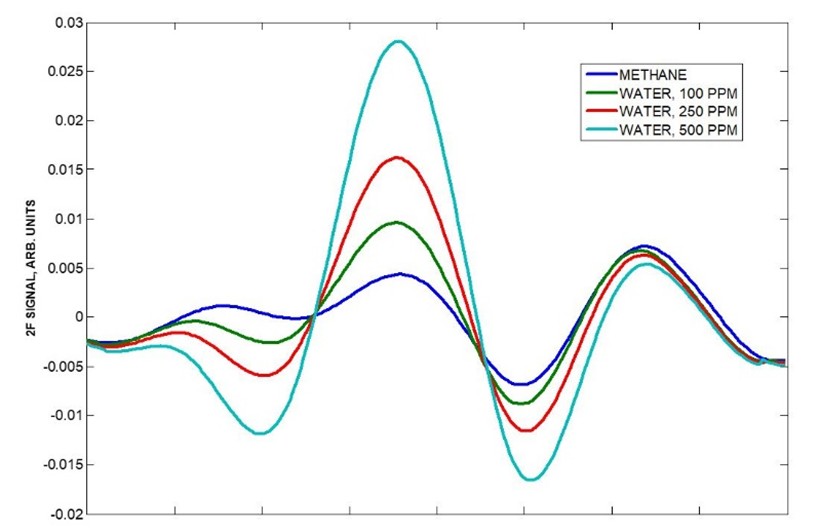
Figure 2: Energy measurement for varying concentrations of water present in Methane.
The AMETEK 5100 analyzer series splits the laser beam sending one beam through a reference cell and one through the process gas stream. The laser beam that passes through the reference cell allows the analyzer to “line-lock” on the specific wavelength and offer a continuous verification using the reference cell for a fast accurate measurement. As the laser passes through the sample stream the energy absorbed from the species of interest is directly related to the concentration. A general diagram of an AMETEK TDLAS analyzer is shown in Figure 3.
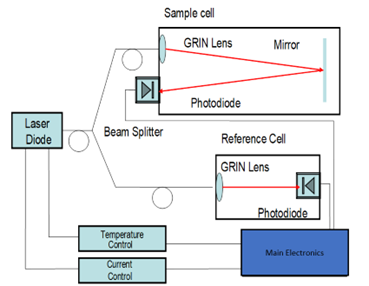
Figure 3: TDLAS laser configuration.
When considering if the 5100 analyzer is suitable for an application there are four things that should be provided: 1. Stream Composition, 2. Phase, 3. Temperature and, 4. Pressure. The most important information is the stream composition as it determines the measurement wavelength and how the analyzer is calibrated. It is possible that other species in the sample stream could absorb energy resulting in measurement interference. This is why knowing the stream composition is necessary to determine if the measurement is possible and if so, how to configure the analyzer accounting for these interferences. The phase, temperature, and pressure of the sample stream are important as well, as these impact the analyzer configuration and are needed to optimize that configuration.
The 5100 series comes in a variety of configurations, based on specific measurement, installation or certification requirements. The 5100 analyzer can also be configured to measure two analytes in the same stream or two separate streams.

Figure 4: AMETEK 5100 Analyzer Series
Click for more information on the 5100 series of TDLAS analyzers.