The official Mains Voltage in the United States and Canada is 120 VAC, 60 Hz. Electrical outlets in homes supply 120 VAC, typically within a tight enough tolerance to keep our electrical devices running smoothly.
Some people refer to the voltage at the outlet as 115 VAC or even 110 VAC. The history of people referring to different mains voltages can date back to the “AC/DC wars” between Thomas Edison and Nikola Tesla in the 1880’s. 110 VAC and 115 VAC are the values used in the past.
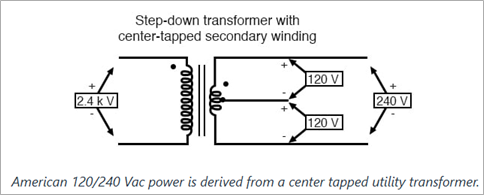
The transformers on a utility pole step down the voltage and supply a split-phase power system to a house with three wires. The 240 VAC supply is sent into the house with a common center-tap. It is split into two 120 VAC circuits at the main circuit breaker panel. The two 120 VAC supplies can also be ‘added together' to provide 240 VAC to an electric range or an electric clothes dryer.
Other countries use different voltages. The most common include 220, 230 and 240 VAC, 50 Hz. Japan uses 100 VAC.
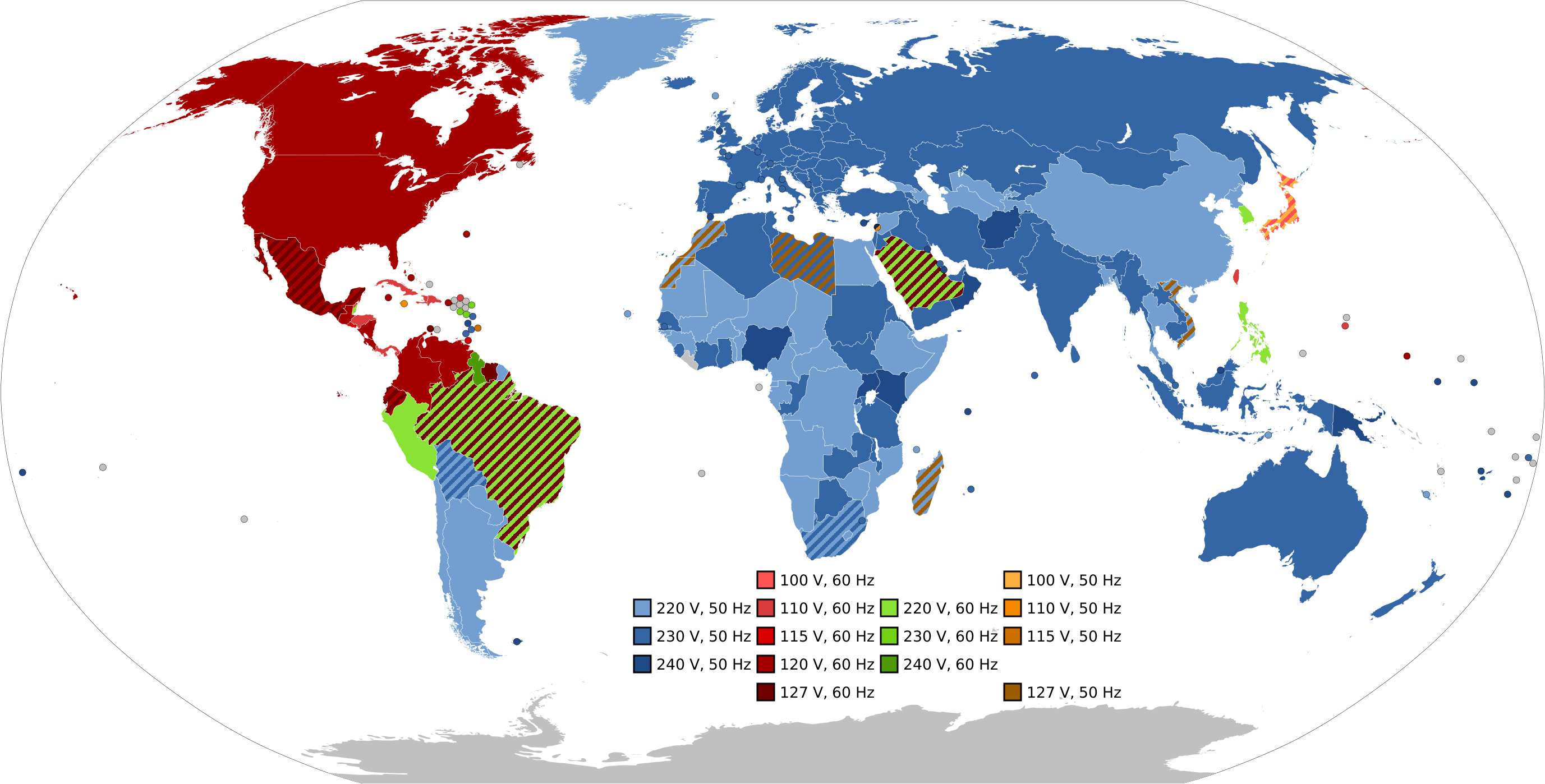
Map Credit: By SomnusDe - This file was derived from: BlankMap-World.svgBased on information from Mains electricity by country and, especially for continental Europe, Länderübersicht Steckertypen, Netzspannungen und -frequenzen, Public Domain, https://commons.wikimedia.org/w/index.php?curid=8781813
Electrical devices have a voltage rating on them. It defines a range of voltages the device can be powered by. For example, a laptop might have 100 – 240V~50-60Hz indicating it can be powered by any of the Mains voltages available. Some devices might just have the Mains Voltage shown or add plus or minus a certain amount. Some motors can show 115 V +/- 10% on the nameplate if they are designed to be powered between 103.5 to 126.5V.
Heating elements and motors can require more power. Sometimes they are powered by less common voltages such as 127V or 208V. Different heating elements are powered by 120 VAC than ones powered by 230 VAC.
When looking at process analyzers, the power ratings / utility requirements of more sophisticated analyzers can be listed as a range or a voltage +/- a certain percentage. Universal power supplies, incorporated into the design of analyzers, can allow them to be used over a large range such as 85 to 264 VAC; 48 to 62 Hz which indicates they can be powered by any of the Mains voltages available including tolerance on the low and high end. Some analyzers will have two different voltage ranges they can be powered by such as either 120 VAC, ±10 %, 50–60 Hz or 240 VAC, ±10 %, 50–60 Hz. The two different ranges are appropriate for different areas of the world.
Devices need to pass electrical testing by an independent Nationally Recognized Testing Laboratory (NRTL) according to certain standards. For example, UL and CAN/CSA C22.2 both have standard 61010-1 which is SAFETY REQUIREMENTS FOR ELECTRICAL EQUIPMENT FOR MEASUREMENT, CONTROL, AND LABORATORY USE – PART 1: GENERAL REQUIREMENTS.
Analyzers need to pass testing for additional standards; especially if they will be installed in a hazardous area.
This blog covers different Mains voltages and how analyzers specifications indicate that they are appropriate for different areas of the world. Many other topics and additional information can be found. It does not address how Root Mean Square (RMS) is used to provide alternating current values. Three-phase voltages are not typically used for analyzers.
References:
NEMA ANSI C84.1v
NFPA 70, National Electrical Code (NEC)
The Rural Electrification Act of 1936 (REA)
UL
CSA
ATEX
IECEx