In laboratories and industrial settings around the world, aspirators perform a useful task: creating suction without any moving parts. Their simplicity comes from a fundamental principle of fluid dynamics known as the Venturi effect. Understanding how aspirators work offers a practical example of physics being harnessed to solve technical problems, and is the sampling method used by AMETEK’s WDG-V analyzer.

An aspirator is a device used to generate a vacuum or draw in gases and liquids. Common examples include laboratory water aspirators used for filtration, medical aspirators for removing fluids, industrial ejectors for material handling and, in our case, measuring oxygen, combustibles, and methane. Unlike mechanical vacuum pumps, our aspirators rely entirely on the movement of instrument air to create suction.
The basis of aspirator operation is the Venturi effect. This phenomenon describes the kinematic changes when fluid flows through a pipe that narrows and then widens again. As the fluid enters the narrow section, its velocity increases. According to Bernoulli’s principle, an increase in fluid velocity corresponds to a decrease in pressure, and this is the key to suction.
In an aspirator, a fast-moving “motive” fluid is forced through a constricted nozzle. At this point of reduced pressure, a side port is connected to the space where suction is desired. Due to pressure naturally equalizing, the fluid from the side port is drawn into the low-pressure region and carried away by the driving fluid. The result is a steady vacuum, achieved without mechanical assistance.
Beyond the laboratory, aspirators play an important role in industry. Air and steam ejectors are used in power plants, chemical processing, and refrigeration systems, where they can handle corrosive gases or high temperatures that would damage mechanical pumps. Because aspirators have no moving parts, they are highly durable and require minimal maintenance.
In essence, aspirators are a practical demonstration of how the Venturi effect transforms kinetic energy into useful work. By cleverly shaping a flow path, engineers can turn a fast-moving fluid into a reliable source of suction. This combination of physics and design confirms aspirators wide use more than a century after the discovery of Venturi effect and are a critical component to the operation of our WDG-V analyzers.
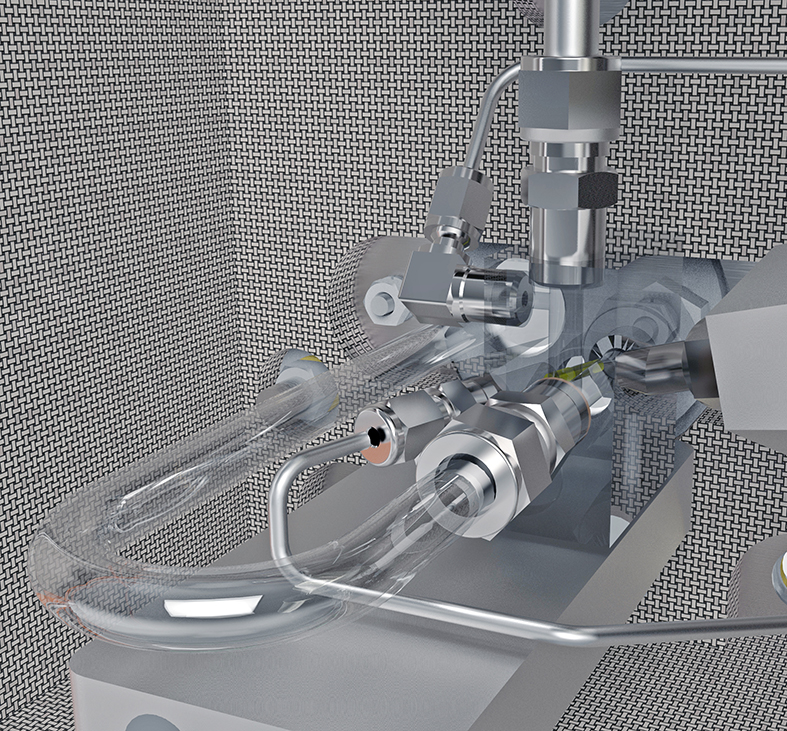
The WDG-V series of analyzers features an aspirator design which incorporates larger orifices that reduce the chance of particulate interference.
Learn more about the WDG-V series of combustion gas analyzers here.